PolylineResampler2d
Transforms an input 2D polyline into a new polygonal chain with line segments of constant length.
Access to parameter description
The new polyline vertices can be computed with a linear, a cubic, or a cubic with Paul Breeuwsma coefficients (Catmull-Rom spline) interpolation.
The target segment length is defined by the spacing parameter.
Figure 1. Polyline resampling: (a) input polyline with irregular segment lengths,
(b) resampling with a small spacing,@Br (c) resampling with a large spacing,
(d) large spacing polyline overlaying the input polyline
See also
Access to parameter description
The new polyline vertices can be computed with a linear, a cubic, or a cubic with Paul Breeuwsma coefficients (Catmull-Rom spline) interpolation.
The target segment length is defined by the spacing parameter.
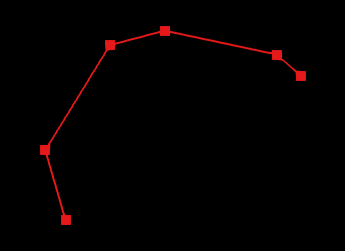 (a) |
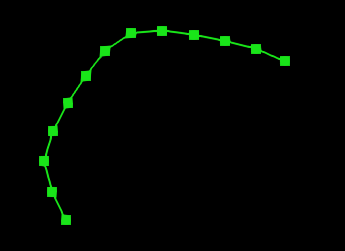 (b) |
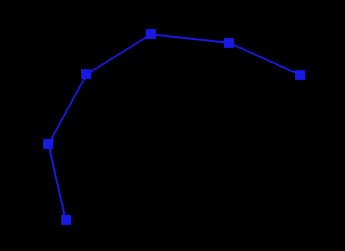 (c) |
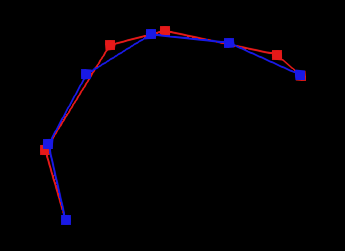 (d) |
See also
Function Syntax
This function returns outputPolyline.
// Function prototype
std::shared_ptr<iolink::ArrayXd>
polylineResampler2d( std::shared_ptr<iolink::ArrayXd> inputPolyline,
                     double spacing,
                     PolylineResampler2d::InterpolationType interpolationType,
                     std::shared_ptr<iolink::ArrayXd> outputPolyline = nullptr );
This function returns outputPolyline.
// Function prototype.
polyline_resampler_2d(input_polyline: Union[idt.NDArrayFloat, None],
                      spacing: float = 1,
                      interpolation_type: Union[Literal["LINEAR"],Literal["CUBIC"],Literal["CATMULL_ROM"],PolylineResampler2d.InterpolationType] = PolylineResampler2d.InterpolationType.LINEAR,
                      output_polyline: Union[idt.NDArrayFloat, None] = None) -> Union[idt.NDArrayFloat, None]
This function returns outputPolyline.
// Function prototype.
public static IOLink.ArrayXd
PolylineResampler2d( IOLink.ArrayXd inputPolyline,
                     double spacing = 1,
                     PolylineResampler2d.InterpolationType interpolationType = ImageDev.PolylineResampler2d.InterpolationType.LINEAR,
                     IOLink.ArrayXd outputPolyline = null );
Class Syntax
Parameters
| Parameter Name | Description | Type | Supported Values | Default Value | |||||||
|---|---|---|---|---|---|---|---|---|---|---|---|
 |
inputPolyline |
The input ArrayXd to resample.
The indexation needs to be {coordinate, index}, where coordinate is the axis index (0 for X and 1 for Y) and index is a label identifying the vertex. |
ArrayXd | nullptr | |||||||
|
spacing |
The spacing between each vertex of the output polyline.
This spacing is expressed in world coordinates. |
Float64 | >=0 | 1 | ||||||
|
interpolationType |
The interpolation mode.
This parameter defines the method used to calculate the polyline interpolated points.
|
Enumeration | LINEAR | |||||||
 |
outputPolyline |
The output resampled polyline.
The indexation of the generated arrayX is {coordinate, index}, where coordinate is the axis index (0 for X and 1 for Y) and index is a label identifying the vertex. |
ArrayXd | nullptr | |||||||
| Parameter Name | Description | Type | Supported Values | Default Value | |||||||
|---|---|---|---|---|---|---|---|---|---|---|---|
|
input_polyline |
The input ArrayXd to resample.
The indexation needs to be {coordinate, index}, where coordinate is the axis index (0 for X and 1 for Y) and index is a label identifying the vertex. |
arrayXd | nullptr | |||||||
|
spacing |
The spacing between each vertex of the output polyline.
This spacing is expressed in world coordinates. |
float64 | >=0 | 1 | ||||||
|
interpolation_type |
The interpolation mode.
This parameter defines the method used to calculate the polyline interpolated points.
|
enumeration | LINEAR | |||||||
|
output_polyline |
The output resampled polyline.
The indexation of the generated arrayX is {coordinate, index}, where coordinate is the axis index (0 for X and 1 for Y) and index is a label identifying the vertex. |
arrayXd | nullptr | |||||||
| Parameter Name | Description | Type | Supported Values | Default Value | |||||||
|---|---|---|---|---|---|---|---|---|---|---|---|
|
inputPolyline |
The input ArrayXd to resample.
The indexation needs to be {coordinate, index}, where coordinate is the axis index (0 for X and 1 for Y) and index is a label identifying the vertex. |
ArrayXd | nullptr | |||||||
|
spacing |
The spacing between each vertex of the output polyline.
This spacing is expressed in world coordinates. |
Float64 | >=0 | 1 | ||||||
|
interpolationType |
The interpolation mode.
This parameter defines the method used to calculate the polyline interpolated points.
|
Enumeration | LINEAR | |||||||
|
outputPolyline |
The output resampled polyline.
The indexation of the generated arrayX is {coordinate, index}, where coordinate is the axis index (0 for X and 1 for Y) and index is a label identifying the vertex. |
ArrayXd | nullptr | |||||||
Object Examples
std::shared_ptr< iolink::ArrayXd> polyline2d_1( new iolink::ArrayXd( { 0 } ) );
readArrayXd( std::string( IMAGEDEVDATA_OBJECTS_FOLDER ) + "polyline2d_1.arrayxd", polyline2d_1);

PolylineResampler2d polylineResampler2dAlgo;
polylineResampler2dAlgo.setInputPolyline( polyline2d_1 );
polylineResampler2dAlgo.setSpacing( 1 );
polylineResampler2dAlgo.setInterpolationType( PolylineResampler2d::InterpolationType::LINEAR );
polylineResampler2dAlgo.execute();

std::cout << "outputPolyline:" << polylineResampler2dAlgo.outputPolyline()->shape();
polyline_2d_1 = np.zeros(0, dtype=np.double)
polyline_2d_1 = imagedev.read_array_xd(imagedev_data.get_object_path("polyline2d_1.arrayxd"), polyline_2d_1)

polyline_resampler_2d_algo = imagedev.PolylineResampler2d()
polyline_resampler_2d_algo.input_polyline = polyline_2d_1
polyline_resampler_2d_algo.spacing = 1
polyline_resampler_2d_algo.interpolation_type = imagedev.PolylineResampler2d.LINEAR
polyline_resampler_2d_algo.execute()

print("output_polyline:", str(polyline_resampler_2d_algo.output_polyline))
IOLink.ArrayXd polyline2d_1 = new IOLink.ArrayXd(new IOLink.VectorXu64( 0 ) ) ;
polyline2d_1 = Data.ReadArrayXd( @"Data/objects/polyline2d_1.arrayxd", polyline2d_1 );

PolylineResampler2d polylineResampler2dAlgo = new PolylineResampler2d
{
    inputPolyline = polyline2d_1,
    spacing = 1,
    interpolationType = PolylineResampler2d.InterpolationType.LINEAR
};
polylineResampler2dAlgo.Execute();

Console.WriteLine( "outputPolyline:" + polylineResampler2dAlgo.outputPolyline.ToString() );
Function Examples
std::shared_ptr< iolink::ArrayXd> polyline2d_1( new iolink::ArrayXd( { 0 } ) );
readArrayXd( std::string( IMAGEDEVDATA_OBJECTS_FOLDER ) + "polyline2d_1.arrayxd", polyline2d_1);

auto result = polylineResampler2d( polyline2d_1, 1, PolylineResampler2d::InterpolationType::LINEAR );

std::cout << "outputPolyline:" << result->shape();
polyline_2d_1 = np.zeros(0, dtype=np.double)
polyline_2d_1 = imagedev.read_array_xd(imagedev_data.get_object_path("polyline2d_1.arrayxd"), polyline_2d_1)

result = imagedev.polyline_resampler_2d(polyline_2d_1, 1, imagedev.PolylineResampler2d.LINEAR)

print("output_polyline:", str(result))
IOLink.ArrayXd polyline2d_1 = new IOLink.ArrayXd(new IOLink.VectorXu64( 0 ) ) ;
polyline2d_1 = Data.ReadArrayXd( @"Data/objects/polyline2d_1.arrayxd", polyline2d_1 );

IOLink.ArrayXd result = Processing.PolylineResampler2d( polyline2d_1, 1, PolylineResampler2d.InterpolationType.LINEAR );

Console.WriteLine( "outputPolyline:" + result.ToString() );
© 2026 Thermo Fisher Scientific Inc. All rights reserved.