RichardsonLucyDeconvolution3d
Restores a microscopy three-dimensional image with the Richardson-Lucy deconvolution.
Access to parameter description
This algorithm performs a fixed number of deconvolution steps using the Richardson Lucy deconvolution method which aims to remove the blur induced by the optical system, modelized by a Point Spread Function (PSF).
The process begins with an initial estimate of the output image, which is iteratively refined. At each iteration, the algorithm compares the convolution of the current estimate with the input PSF and updates the estimate accordingly.
Defining tiling mode and tile sizes can help manage memory usage efficiently, enabling the processing of large images that might otherwise exceed available memory.
Deconvolution algorithms can be memory-intensive because they operate in the Fourier domain and therefore require computing FFTs on both the input image and the point spread function (PSF). Although the PSF is initially much smaller than the input, it must be padded to the full image size before the FFT so that the convolution can be performed correctly. This padding, combined with the complex-valued intermediate buffers needed by the FFT, can lead to very high memory consumption on large images. Tiling helps reduce this footprint by performing the FFTs on smaller subregions, making it feasible to process datasets that would otherwise exceed the available system memory.
The deconvolution can be performed on spectal images but need a spectral PSF to work properly.
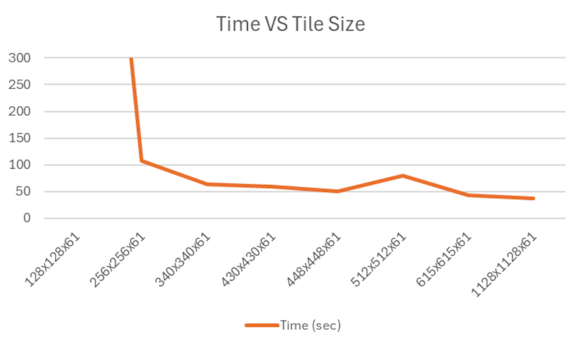
Figure 1. Evolution of the computation time relatively to the tile size. (Experimentations done a 1128x1128x80 data set with a 51x51x15 PSF and an Intel(R) Core(TM) i7-10850H CPU, 2.70 GHz, 12 logical processors))
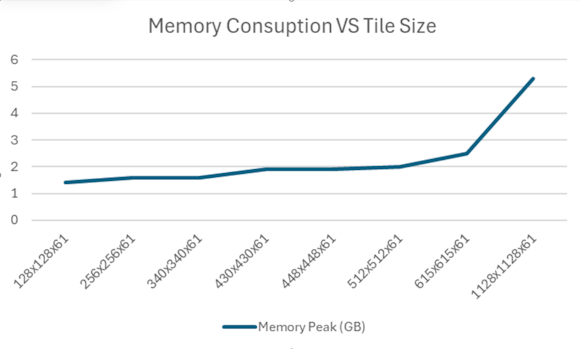
Figure 2. Evolution of the memory consumption relatively to the tile size. (Experimentations done a 1128x1128x80 data set with a 51x51x15 PSF and an Intel(R) Core(TM) i7-10850H CPU, 2.70 GHz, 12 logical processors)
References
See also
Access to parameter description
This algorithm performs a fixed number of deconvolution steps using the Richardson Lucy deconvolution method which aims to remove the blur induced by the optical system, modelized by a Point Spread Function (PSF).
The process begins with an initial estimate of the output image, which is iteratively refined. At each iteration, the algorithm compares the convolution of the current estimate with the input PSF and updates the estimate accordingly.
Defining tiling mode and tile sizes can help manage memory usage efficiently, enabling the processing of large images that might otherwise exceed available memory.
Deconvolution algorithms can be memory-intensive because they operate in the Fourier domain and therefore require computing FFTs on both the input image and the point spread function (PSF). Although the PSF is initially much smaller than the input, it must be padded to the full image size before the FFT so that the convolution can be performed correctly. This padding, combined with the complex-valued intermediate buffers needed by the FFT, can lead to very high memory consumption on large images. Tiling helps reduce this footprint by performing the FFTs on smaller subregions, making it feasible to process datasets that would otherwise exceed the available system memory.
The deconvolution can be performed on spectal images but need a spectral PSF to work properly.
Figure 1. Evolution of the computation time relatively to the tile size. (Experimentations done a 1128x1128x80 data set with a 51x51x15 PSF and an Intel(R) Core(TM) i7-10850H CPU, 2.70 GHz, 12 logical processors))
Figure 2. Evolution of the memory consumption relatively to the tile size. (Experimentations done a 1128x1128x80 data set with a 51x51x15 PSF and an Intel(R) Core(TM) i7-10850H CPU, 2.70 GHz, 12 logical processors)
References
- W.H. Richardson. "Bayesian-Based Iterative Method of Image Restoration". Journal of the Optical Society of America, vol. v62, is. 1, pp. 55-59, 1972.
- L.B. Lucy, An iterative technique for the rectification of observed distributions , Astronomical Journal, vol. 79, is. 6, pp. 745-754, 1974.
See also
Function Syntax
This function returns outputImage.
// Function prototype
std::shared_ptr< iolink::ImageView >
richardsonLucyDeconvolution3d( std::shared_ptr< iolink::ImageView > inputImage,
                               std::shared_ptr< iolink::ImageView > inputPsfImage,
                               uint32_t numberOfIterations,
                               RichardsonLucyDeconvolution3d::InitialEstimate initialEstimate,
                               RichardsonLucyDeconvolution3d::TilingMode tilingMode,
                               const iolink::Vector3u32& tileSize,
                               std::shared_ptr< iolink::ImageView > outputImage = nullptr );
This function returns outputImage.
// Function prototype.
richardson_lucy_deconvolution_3d(input_image: idt.ImageType,
                                 input_psf_image: idt.ImageType,
                                 number_of_iterations: int = 10,
                                 initial_estimate: Union[Literal["CONSTANT"],Literal["INPUT_IMAGE"],RichardsonLucyDeconvolution3d.InitialEstimate] = RichardsonLucyDeconvolution3d.InitialEstimate.CONSTANT,
                                 tiling_mode: Union[Literal["NONE"],Literal["USER_DEFINED"],Literal["USER_DEFINED_LOW_MEMORY"],RichardsonLucyDeconvolution3d.TilingMode] = RichardsonLucyDeconvolution3d.TilingMode.NONE,
                                 tile_size: Iterable[int] = [256, 256, 256],
                                 output_image: idt.ImageType = None) -> idt.ImageType
This function returns outputImage.
// Function prototype.
public static IOLink.ImageView
RichardsonLucyDeconvolution3d( IOLink.ImageView inputImage,
                               IOLink.ImageView inputPsfImage,
                               UInt32 numberOfIterations = 10,
                               RichardsonLucyDeconvolution3d.InitialEstimate initialEstimate = ImageDev.RichardsonLucyDeconvolution3d.InitialEstimate.CONSTANT,
                               RichardsonLucyDeconvolution3d.TilingMode tilingMode = ImageDev.RichardsonLucyDeconvolution3d.TilingMode.NONE,
                               uint[] tileSize = null,
                               IOLink.ImageView outputImage = null );
Class Syntax
Parameters
| Parameter Name | Description | Type | Supported Values | Default Value | |||||||
|---|---|---|---|---|---|---|---|---|---|---|---|
 |
inputImage |
The input image. | Image | Grayscale or Multispectral | nullptr | ||||||
|
inputPsfImage |
The point spread function (PSF) that models the degradation filter. The PSF is passed as an image. It is recommended to use a PSF with an odd size. | Image | Grayscale or Multispectral | nullptr | ||||||
|
numberOfIterations |
The number of iterations performed. | UInt32 | [1, 1000] | 10 | ||||||
|
initialEstimate |
The initial estimate of the deconvolution algorithm. If CONSTANT is chosen, a constant image is used initially. Often, this yields smoother results than the second option, namely input data.
|
Enumeration | CONSTANT | |||||||
|
tilingMode |
The way to manage the memory.
|
Enumeration | NONE | |||||||
|
tileSize |
The tile width and height in pixels. This parameter is used only in USER_DEFINED tiling mode. | Vector3u32 | Any value | {256, 256, 256} | ||||||
 |
outputImage |
The output image. The output image characteristics are forced to the same as the input image. | Image | nullptr | |||||||
| Parameter Name | Description | Type | Supported Values | Default Value | |||||||
|---|---|---|---|---|---|---|---|---|---|---|---|
|
input_image |
The input image. | image | Grayscale or Multispectral | None | ||||||
|
input_psf_image |
The point spread function (PSF) that models the degradation filter. The PSF is passed as an image. It is recommended to use a PSF with an odd size. | image | Grayscale or Multispectral | None | ||||||
|
number_of_iterations |
The number of iterations performed. | uint32 | [1, 1000] | 10 | ||||||
|
initial_estimate |
The initial estimate of the deconvolution algorithm. If CONSTANT is chosen, a constant image is used initially. Often, this yields smoother results than the second option, namely input data.
|
enumeration | CONSTANT | |||||||
|
tiling_mode |
The way to manage the memory.
|
enumeration | NONE | |||||||
|
tile_size |
The tile width and height in pixels. This parameter is used only in USER_DEFINED tiling mode. | vector3u32 | Any value | [256, 256, 256] | ||||||
|
output_image |
The output image. The output image characteristics are forced to the same as the input image. | image | None | |||||||
| Parameter Name | Description | Type | Supported Values | Default Value | |||||||
|---|---|---|---|---|---|---|---|---|---|---|---|
|
inputImage |
The input image. | Image | Grayscale or Multispectral | null | ||||||
|
inputPsfImage |
The point spread function (PSF) that models the degradation filter. The PSF is passed as an image. It is recommended to use a PSF with an odd size. | Image | Grayscale or Multispectral | null | ||||||
|
numberOfIterations |
The number of iterations performed. | UInt32 | [1, 1000] | 10 | ||||||
|
initialEstimate |
The initial estimate of the deconvolution algorithm. If CONSTANT is chosen, a constant image is used initially. Often, this yields smoother results than the second option, namely input data.
|
Enumeration | CONSTANT | |||||||
|
tilingMode |
The way to manage the memory.
|
Enumeration | NONE | |||||||
|
tileSize |
The tile width and height in pixels. This parameter is used only in USER_DEFINED tiling mode. | Vector3u32 | Any value | {256, 256, 256} | ||||||
|
outputImage |
The output image. The output image characteristics are forced to the same as the input image. | Image | null | |||||||
Object Examples
auto foam = readVipImage( std::string( IMAGEDEVDATA_IMAGES_FOLDER ) + "foam.vip" );
auto kernel_2d = readVipImage( std::string( IMAGEDEVDATA_IMAGES_FOLDER ) + "kernel_2d.vip" );

RichardsonLucyDeconvolution3d richardsonLucyDeconvolution3dAlgo;
richardsonLucyDeconvolution3dAlgo.setInputImage( foam );
richardsonLucyDeconvolution3dAlgo.setInputPsfImage( kernel_2d );
richardsonLucyDeconvolution3dAlgo.setNumberOfIterations( 5 );
richardsonLucyDeconvolution3dAlgo.setInitialEstimate( RichardsonLucyDeconvolution3d::InitialEstimate::CONSTANT );
richardsonLucyDeconvolution3dAlgo.setTilingMode( RichardsonLucyDeconvolution3d::TilingMode::USER_DEFINED );
richardsonLucyDeconvolution3dAlgo.setTileSize( {32, 32, 32} );
richardsonLucyDeconvolution3dAlgo.execute();

std::cout << "outputImage:" << richardsonLucyDeconvolution3dAlgo.outputImage()->toString();
foam = imagedev.read_vip_image(imagedev_data.get_image_path("foam.vip"))
kernel_2d = imagedev.read_vip_image(imagedev_data.get_image_path("kernel_2d.vip"))

richardson_lucy_deconvolution_3d_algo = imagedev.RichardsonLucyDeconvolution3d()
richardson_lucy_deconvolution_3d_algo.input_image = foam
richardson_lucy_deconvolution_3d_algo.input_psf_image = kernel_2d
richardson_lucy_deconvolution_3d_algo.number_of_iterations = 5
richardson_lucy_deconvolution_3d_algo.initial_estimate = imagedev.RichardsonLucyDeconvolution3d.CONSTANT
richardson_lucy_deconvolution_3d_algo.tiling_mode = imagedev.RichardsonLucyDeconvolution3d.USER_DEFINED
richardson_lucy_deconvolution_3d_algo.tile_size = [32, 32, 32]
richardson_lucy_deconvolution_3d_algo.execute()

print("output_image:", str(richardson_lucy_deconvolution_3d_algo.output_image))
ImageView foam = Data.ReadVipImage( @"Data/images/foam.vip" );
ImageView kernel_2d = Data.ReadVipImage( @"Data/images/kernel_2d.vip" );

RichardsonLucyDeconvolution3d richardsonLucyDeconvolution3dAlgo = new RichardsonLucyDeconvolution3d
{
    inputImage = foam,
    inputPsfImage = kernel_2d,
    numberOfIterations = 5,
    initialEstimate = RichardsonLucyDeconvolution3d.InitialEstimate.CONSTANT,
    tilingMode = RichardsonLucyDeconvolution3d.TilingMode.USER_DEFINED,
    tileSize = new uint[]{32, 32, 32}
};
richardsonLucyDeconvolution3dAlgo.Execute();

Console.WriteLine( "outputImage:" + richardsonLucyDeconvolution3dAlgo.outputImage.ToString() );
Function Examples
auto foam = readVipImage( std::string( IMAGEDEVDATA_IMAGES_FOLDER ) + "foam.vip" );
auto kernel_2d = readVipImage( std::string( IMAGEDEVDATA_IMAGES_FOLDER ) + "kernel_2d.vip" );

auto result = richardsonLucyDeconvolution3d( foam, kernel_2d, 5, RichardsonLucyDeconvolution3d::InitialEstimate::CONSTANT, RichardsonLucyDeconvolution3d::TilingMode::USER_DEFINED, {32, 32, 32} );

std::cout << "outputImage:" << result->toString();
foam = imagedev.read_vip_image(imagedev_data.get_image_path("foam.vip"))
kernel_2d = imagedev.read_vip_image(imagedev_data.get_image_path("kernel_2d.vip"))

result = imagedev.richardson_lucy_deconvolution_3d(foam, kernel_2d, 5, imagedev.RichardsonLucyDeconvolution3d.CONSTANT, imagedev.RichardsonLucyDeconvolution3d.USER_DEFINED, [32, 32, 32])

print("output_image:", str(result))
ImageView foam = Data.ReadVipImage( @"Data/images/foam.vip" );
ImageView kernel_2d = Data.ReadVipImage( @"Data/images/kernel_2d.vip" );

IOLink.ImageView result = Processing.RichardsonLucyDeconvolution3d( foam, kernel_2d, 5, RichardsonLucyDeconvolution3d.InitialEstimate.CONSTANT, RichardsonLucyDeconvolution3d.TilingMode.USER_DEFINED, new uint[]{32, 32, 32} );

Console.WriteLine( "outputImage:" + result.ToString() );
© 2026 Thermo Fisher Scientific Inc. All rights reserved.