 |
IOLink 1.16.1
|
|
IOLink 1.16.1
|
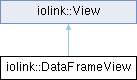
View to model tabular data. More...
#include <iolink/view/DataFrameView.h>
Public Member Functions | |
| virtual DataFrameCapabilitySet | capabilities () const =0 |
| Return the view's capabilities. | |
| virtual const Vector2u64 & | shape () const =0 |
| Return the shape of the data frame. | |
| virtual const std::string & | columnName (size_t index) const =0 |
| Get the name of a column from its index. | |
| virtual size_t | columnIndex (const std::string &name) const =0 |
| Get the index of a column from its name. | |
| virtual DataType | columnDataType (size_t index) const =0 |
| Return the data type of the column. | |
| virtual void | read (size_t column, size_t offset, size_t count, void *dst) const |
| Read data from a column. | |
| template<typename T > | |
| T | at (size_t column, size_t row) const |
| Get the value stored in a cell of the data frame. | |
| template<typename T > | |
| T | at (const std::string &columnName, size_t row) const |
| Get the value stored in a cell of the data frame. | |
| const std::string & | unit (size_t columnIndex) |
| Gives the unit of given column. | |
| virtual void | write (size_t column, size_t offset, size_t count, const void *src) |
| Write data into a column. | |
| template<typename T > | |
| void | setAt (size_t column, size_t row, T value) |
| Set the element value in a cell of the data frame. | |
| template<typename T > | |
| void | setAt (const std::string &columnName, size_t row, T value) |
| Set the element value in a cell of the data frame. | |
| void | setUnit (size_t columnIndex, const std::string &unit) |
| Set the unit of the column. | |
| virtual void | addColumn (const std::string &name, DataType dtype) |
| Add a column to the dataframe. | |
| virtual void | addRows (size_t offset, size_t count) |
| Insert rows at the specified position. | |
| virtual void | removeColumn (size_t index) |
| Remove a column. | |
| virtual void | removeRows (size_t offset, size_t count) |
| Remove a continuous set of rows. | |
| std::string | toString () const |
| Return a string representation. | |
| void | reshape (const Vector2u64 &shape, const std::string *columnNames, const DataType *columnDataTypes) |
| Method to reshape a DataFrame. | |
| void | setColumnName (const std::string &columnName, const std::string &newName) |
| Set the name of a column identified with its name. | |
| void | setColumnName (size_t index, const std::string &newName) |
| Set the name of a column identified with its index. | |
 Public Member Functions inherited from iolink::View Public Member Functions inherited from iolink::View | |
| virtual std::shared_ptr< Extension > | extension (size_t id) |
| Get an extension of the view, corresponding to the given identifier. | |
| template<typename T > | |
| std::shared_ptr< T > | extension () |
| Get an extension of the view, corresponding to the given type. | |
| std::shared_ptr< ViewOriginExtension > | viewOrigin () |
| Shortcut to access to ViewOrigin extension. | |
View to model tabular data.
This view is composed of a set of columns, that have a name and a data type. A column's name is unique, and columns in a dataframe can have different data types.
Each column has the same number of elements. The aggregate of all n-th elements of columns are a row of the dataframe.
|
virtual |
Add a column to the dataframe.
This method requires the RESHAPE capability.
The new column's data will be undefined after addition.
| name | The name of the new column. |
| dtype | The type of data stored in the column. |
| NotImplemented | When the view does not support reshaping. |
| Error | if there is already a column with the same name. |
| Error | if the implementation does not support the data type. |
|
virtual |
Insert rows at the specified position.
This method requires the RESHAPE capability.
New rows content will be undefined after insertion.
| offset | New rows will be inserted before this row. If the offset is the number of rows in the dataframe, rows will be inserted at the end. |
| count | The number of rows to insert. |
| NotImplemented | When the view does not support reshaping. |
| Error | When offset is out of bounds. |
| Error | When it is impossible to add these rows. |
|
inline |
Get the value stored in a cell of the data frame.
| T | The type of the data stored in the cell. |
| columnName | The name of the column where to get the cell. |
| row | The index of the row |
|
inline |
Get the value stored in a cell of the data frame.
| T | The type of the data stored in the cell. |
| column | The index of the column |
| row | The index of the row |
| Error | if the column or the cell index is out of bounds. |
|
pure virtual |
Return the view's capabilities.
|
pure virtual |
Return the data type of the column.
| index | The index of the column. |
| Error | When index is out of range. |
|
pure virtual |
Get the index of a column from its name.
| name | The name of the column. |
| Error | If there is no column with that name. |
|
pure virtual |
Get the name of a column from its index.
Column indices go from 0 to shape[0] - 1.
| index | The index of the column. |
| Error | If index is out of range. |
|
virtual |
Read data from a column.
This method requires the READ capability.
When reading numeric data, the dst buffer will be filled with continuous values. In the case of strings, it will be a continuous array of string objects.
The destination buffer must be allocated by the user. If its size is under the byte count needed to store the request number of elements, a segmentation fault will rise, as there is no boundaries check.
| column | The index of the column to read from. |
| offset | The index of the first element to read. |
| count | The number of elements to read. |
| dst | A buffer where the read data will be written. |
| NotImplemented | When the view does not support reading. |
| Error | When dst is null. |
| Error | When the column index is invalid. |
| Error | When offset is out of bounds. |
| Error | If it is impossible to read the number of elements required. |
|
virtual |
Remove a column.
This method requires the RESHAPE capability.
| index | The index of the column to remove. |
| NotImplemented | When the view does not support reshaping. |
| Error | If the index is out of bounds. |
| Error | When it is impossible to remove that column. |
|
virtual |
Remove a continuous set of rows.
This method requires the RESHAPE capability.
| offset | The index of the first column to remove. |
| count | Row count to delete. |
| NotImplemented | When the view does not support reshaping. |
| Error | When offset is out of bounds. |
| Error | When it is impossible to remove these rows. |
| void iolink::DataFrameView::reshape | ( | const Vector2u64 & | shape, |
| const std::string * | columnNames, | ||
| const DataType * | columnDataTypes | ||
| ) |
Method to reshape a DataFrame.
This method requires the RESHAPE capability.
All the dataframe's data is invalidated after this operation.
| shape | shape of the allocated dataframe (column count, row count) |
| columnNames | Array which contains the name for each column |
| columnDataTypes | Array which contains the data type of each column |
|
inline |
Set the element value in a cell of the data frame.
| T | The type of the data stored in the cell. |
| columnName | The name of the column where to set the cell. |
| row | The row of the cell to set. |
| value | The value to store in the cell. |
|
inline |
Set the element value in a cell of the data frame.
| T | The type of the data stored in the cell. |
| column | The column of the cell to set. |
| row | The row of the cell to set. |
| value | The value to store in the cell. |
| void iolink::DataFrameView::setColumnName | ( | const std::string & | columnName, |
| const std::string & | newName | ||
| ) |
Set the name of a column identified with its name.
| columnName | The name of the column to rename. |
| newName | The name to assign to the column. |
| Error | if the given column name does not exist in the DataFrame. |
| InvalidArgument | if the given new name already exists in the DataFrame. |
| Error | if DataFrameView does not have the WRITE capability. |
| void iolink::DataFrameView::setColumnName | ( | size_t | index, |
| const std::string & | newName | ||
| ) |
Set the name of a column identified with its index.
| columnIndex | The index of the column to rename. |
| newName | The name to assign to the column. |
| Error | if the given column index is out of range. |
| InvalidArgument | if the given new name already exists in the DataFrame. |
| Error | if DataFrameView does not have the WRITE capability. |
| void iolink::DataFrameView::setUnit | ( | size_t | columnIndex, |
| const std::string & | unit | ||
| ) |
Set the unit of the column.
| columnIndex | The index of the column. |
| unit | The unit of the column. |
| Error | if the column index is out of range. |
| Error | if DataFrameView does not have the WRITE capability. |
|
pure virtual |
Return the shape of the data frame.
First element being the number of columns, and the second, the number of rows.
| const std::string & iolink::DataFrameView::unit | ( | size_t | columnIndex | ) |
Gives the unit of given column.
| columnIndex | The index of the column. |
| Error | If the column index is out of bounds. |
|
virtual |
Write data into a column.
This method requires the WRITE capability.
When writing numeric data, the src buffer must be filled with continuous values. In the case of strings, the source must use a continuous array of string objects.
The source buffer must be allocated by the user. If its size is under the byte count needed to store the request number of elements, a segmentation fault will rise, as there is no boundaries check.
| column | The index of the column to write into. |
| offset | The index of the first element to write. |
| count | The number of element to write. |
| src | A buffer whose content will be written in the column. |
| NotImplemented | When the view does not support writing. |
| Error | When src is null. |
| Error | When the column index is invalid. |
| Error | When offset is out of bounds. |
| Error | If it is impossible to write the number of elements required. |
 1.9.8
1.9.8